Showing posts with label Classical Writing. Show all posts

Thursday, January 15, 2009

Writer of the Week

Here is a full Maxim essay that Zachary wrote for Diogenes. For this assignment, each student chose a Maxim to amplify. (Previous weeks had the Maxim assigned.)


Wisdom vs. Folly

“A wise son brings joy to his father, but a foolish son grief to his mother.” ~ Solomon

by Zachary (age 13)

All wise writers deserve admiration, but none so much as Solomon, the third king of ancient Israel. When God told Solomon to ask for whatever he wanted God to give him, Solomon chose wisdom over personal wealth, a long life, or any other selfish desire. He ruled with great diplomacy and never used much military force. Of all the maxims and proverbs he wrote, his teaching on how wise sons please their parents must be one of the finest.

This maxim speaks of how children who live with respect towards the knowledge and fear of God and who are devoted to obedience to His commands will please their parents. In contrast, children acting without regard to the laws of God will cause their parents grief. The wisdom of this maxim will be observed in the sections below.

The person who heeds this maxim will discover what is right, or true, according to Scripture. He will also learn what is upright in God’s eyes, understand the fear of the Lord, and find the knowledge of God. He will have favor with God and man, and his reward will be eternal life.

In contrast, if someone disregards this maxim and chooses foolishness over wisdom, then he will not know what is right according to God’s will. He will not have knowledge of God or a fear of the Lord. This kind of man is what Scripture warns us against imitating; he is a perfect example of what not to emulate. He will reap destruction in the end.

Such is also the situation with students. The student who pays attention in class and studies hard will bring joy to his teacher by displaying appreciation of the teacher’s time. But the student who does not pay attention in class and entertains himself rather than studying will discover that his teacher will not be pleased with him, since the teacher wasted his time teaching a student who does not appreciate his time and effort.

An example of this maxim is the Parable of the Prodigal Son told by Jesus. The son asked his father for his inheritance early, and when he received it, he moved away to the city. There he wasted his money on his own pleasure, and quickly exhausted his resources. He decided to return to his father’s house, but planned to ask to be a slave since he had sinned against his father. When he returned, his father, having been worried about him, welcomed him with excitement and refused to let his son be his slave. His father had the fattest cow slaughtered and a feast was held to celebrate his son’s return to living wisely.

Cicero, the great Roman philosopher and orator, testified to the wisdom of this maxim when he said, “The function of wisdom is to discriminate between good and evil.”

When all of this is considered, can Solomon possibly be admired and praised enough for his wise saying on wisdom and folly?

Friday, January 9, 2009

Writer of the Week

This is Ryan's first full essay based on the Maxim progymnasmata as taught in the Diogenes material.

(I described the Classical Writing program here.)


Responsible Living

“Would you live with ease? Do what you ought, and not what you please.”

by Ryan (age 13)

It is proper to praise every writer, but especially Benjamin Franklin, the famous printer, publisher, diplomat, scientist, and statesman of 18th century America. He was a wise and very active man who published a successful paper and Poor Richard’s Almanac, wrote letters to the local newspaper as a boy, patented numerous inventions, proved that lighting is indeed electricity, and signed many of the key founding documents in American history. It has been said Benjamin Franklin was a “jack of all trades, master of many.” His wise sayings were widely known throughout all of the American colonies, and were normally associated with a common sense viewpoint which made him and his almanac very popular. None of his observations were so wise as those he made on doing your duty.

What does the maxim say? If one desires to be trouble-free in this world he should carry out his duties rather than simply doing whatever he wishes. One should make it a habit to live everyday with this attitude if he wishes to live with ease. We shall praise the author in what follows.

The consequence of this maxim is that he who completes the tasks required of him will have a more comfortable life. He will save money, and he can provide for the future with it; he will be sought after as an employee, as well as an employer. People are more likely to appreciate the man who can be counted on to complete his obligations, which will result in smoother lives for those around him as well.

On the contrary, if one were to only do what he wished rather than the necessary everyday tasks, he would not be sought after as an employee or employer, since others would not appreciate him because he would be considered very unreliable.

Such is also the way with farmers who plant their crops; those who are willing to keep their plants healthy throughout the season by watering and taking care of them will have a harvest of food for himself as well as his family.

This maxim is illustrated in Aesop’s fable, The Ant and the Grasshopper, in which the ant labors and builds up a supply of food all year long while the grasshopper merely ridicules him for wasting his time working instead of enjoying life. When winter comes the diligent ant has enough food for the whole season, but the lazy grasshopper dies from starvation.

Solomon, the Old Testament king who chose wisdom over all his other desires, said, “In the house of the wise are stores of choice food and oil, but a foolish man devours all he has.”

It is easy to see the wisdom of the author, Benjamin Franklin, when he wrote such things about living problem-free by simply doing our duty.

Saturday, December 6, 2008

Writer of the Week


The Good Samaritan

retold by Catherine (age 11)


Jesus then spoke saying, “Once a man was traveling from Jerusalem to Jericho. On his way he was attacked by robbers who tore his clothes, stole his money, hurt him, and left him to die. After some time, a priest came down the road and saw the man half dead, but continued on. Soon a Levite was passing by; he, too, saw the man, cared nothing for him, and went on. Then a Samaritan, who was despised by others, came by. He saw the man on the ground dying, but did not pass on. He bandaged the man’s cuts and took him to an inn. The next morning, he gave the inn keeper two pence and told him, ‘Please take care of him and when I return I will repay you for anything you may have needed to buy.’ Who was the neighbor of the man who was attacked by the robbers?”

Jesus continued, “The Samaritan, because he showed kindness and love. Go and do as I have told you.”

Thursday, November 20, 2008

Writer of the Week


Diane Kruger as Helen of Troy


The Face That Launched a Thousand Ships

retold by Catherine (age 11)


After becoming a prince of Troy, Paris took a trip to Tyre. When he was returning to his homeland, Troy, he went through Greece. The fairest woman in the world, Helen, was in Greece, and Paris had come to retrieve her.

Helen was married to Menelaus, King of Sparta in Greece. When the prince of Troy laid eyes on the Queen of Sparta, he loved her for she was so beautiful. The goddess Aphrodite made Helen love Paris as well. Paris then took Helen back to Troy.

King Menelaus was angry, and sent word demanding his wife back. But the people of Troy refused. They wanted to brag about Helen, the fairest woman in the world, being in their city. King Priam and Hector, his son, knew that Helen and all her belongings should be returned. But the assembly of Troy would not give up Helen for any king.

Now Agamemnon, king of the great city of Mycenae, was deeply troubled at seeing his dearest brother, Menelaus, being flouted by the Trojans, and vowed to Menelaus that Troy would soon be no more. Agamemnon gathered all the kings and princes of Greece, and suggested, “We must unite all of our strength to take Troy! Upon achieving that, we will gain great treasures!” He also asked Odysseus and Achilles to join the war, and so they did.

Agamemnon’s team went to every city that was an ally of Troy, and took each one. After taking all these cities, they sailed for Troy. Year after year want by, and finally nine years had passed; the Greeks and the Trojans were still fighting. A plague had come during those years and killed more Greeks than the Trojans had. So the war went on, and on, and on; neither side had yet taken the other.

Thursday, November 13, 2008

Writer of the Week

Elizabeth is our writer this week. We again used the techniques described in The Well-Trained Mind and in The Complete Writer: Writing With Ease (both books by Susan Wise Bauer): we read the story together, Elizabeth narrated it to me while I wrote down her narration, and then she copied the narration.


The Wolf and His Shadow
retold by Elizabeth (age 7)


Sunday, November 9, 2008

Writer(s) of the Week

In 1722, when Benjamin Franklin was 16 years old, he wrote a series of humorous letters which were published in The New England Courant, a newspaper owned by his brother, James.

These letters weren't sign with his own name; instead, he utilized the pen name of Silence Dogood. Mrs. Dogood passed herself off as a middle-aged widow, and wrote about various aspects of life in colonial America.

James Franklin was unaware of the ruse for several months, and was unhappy with his brother when Benjamin revealed the true identity of the widow Dogood.

Zachary and Ryan have been analyzing Silence Dogood No. 6 as part of Diogenes. Part of their assignment for this past week was purely for fun: write a paragraph critiquing a current clothing fashion using the same manner as that used by Silence Dogood in her No. 6 letter.

Letters to the Editor

Dear Madam,

In this letter I shall reveal my opinion of a particular Pride of Apparel. I have noticed recently that teenagers commonly wear clothing which is too large for them. This style of clothing is popular, yet I cannot imagine how one would even want to wear such apparel. Their shirts go to their knees; their pants they wear low. It is surprising how anyone manages to walk dressed so awkwardly, and not trip at every attempt. It is very immodest the way they wear their boxers so high yet their pants so low. I do not think I will be able to persuade them to remove this fashion altogether by this letter, but I would at least ask them to wear clothing a bit more fitting.

Anonymous (Zachary)


Dear Madam,

In this letter I shall disclose my thoughts on a most useless apparel that has come to fashion. Namely, those articles of clothing that are bought already with holes and scratches in them. It amazes me to see others purchasing such apparel when they are only purchasing worn out clothing for the price of new. This kind of apparel is worthless, and it makes those who wear it look very odd with such large holes in their new clothing. They are wasting their money on clothes that are already close to being worn out, instead of purchasing clothes that would last them longer. In closing, I would at least desire them to lessen the size of the tears and holes.

Sincerely,

Bob Dogood (Ryan)

I highly recommend taking time to read some of Dogood's letters. They are highly entertaining.

Friday, October 24, 2008

Writer of the Week

Elizabeth won't begin Classical Writing until third grade, but we are doing preparatory work by utilizing narrations, copywork, and dictation as described in The Complete Writer: Writing With Ease by Susan Wise Bauer. (The Well-Trained Mind was co-written by Susan and her mother, Jessie Wise; it also advocates and descibes using narration, copywork, and dictation with young students.)

Elizabeth's reading program, ABeCeDarian, has had her reading Aesop's fables recently. For her writing assignment this week, she narrated the story of The Fox and the Goat to me while I wrote it down for her. She then copied her narration.


The Fox and the Goat
narrated and copied by Elizabeth (age 7)


Saturday, October 18, 2008

Writer of the Week


(Click on the comic strip above to read the words on Catherine's illustration of the story.)

The Golden Apple
retold by Catherine (age 11)

Once there was a city named Troy, which was constructed when the demi-gods walked around the planet. Troy had high walls, tall towers, great gates, and fortresses with mighty men. The rich king of this magnificent city was Priam, who was old and had many sons. One of his sons was Hector. He was brave, strong, noble, and a commander in Troy.

King Priam had another son; his name was Paris. Paris was not like his brother, Hector. He was not strong, noble, nor brave in the least bit. When Paris was a baby, a fortune teller told the king that his son would bring great trouble upon Troy. So Paris was sent away from the city, and was raised in the country where he herded sheep.

Years later, Zeus was hosting a wedding feast for Peleus and Thetis. All the gods and goddesses came except for the one who was not invited: Eris, the goddess of discord. Eris, who loved disharmony, rolled a golden apple into the feast. “For the fairest one” was written on the apple. Three goddesses claimed the apple: Aphrodite, Athene, and Hera. But none of the guests would choose which goddess was fairest, because if they chose one, the other two would never be kind to them again.

About this time, Paris the shepherd walked by the palace where Zeus was hosting the feast. The guests saw him, and asked him to pick the fairest of the three goddesses. Aphrodite, Athene, and Hera each offered Paris a gift if he chose her. Hera would give him power, Athene would make him wise, and Aphrodite would give him the love of the world’s most beautiful woman! Paris chose Aphrodite; Hera and Athene stormed away in anger.

There was just one problem; the world’s most beautiful woman, Helen, was already married! Thus the Trojan War was started!

Saturday, October 11, 2008

Writer of the Week

summary - A presentation of the substance of a body of material in a condensed form or by reducing it to its main points.

precis - a concise summary of a book, an article, or another text.

(Both definitions from The American Heritage Dictionary of the English Language.)

Summarizing and precis writing are two valuable skills taught in the Classical Writing program. Students are presented with a systematic approach to writing a summary paragraph for a body of material. They then learn to further condense their summary paragraph into a one-sentence precis that encapsulates the entire story.

Here are Zachary's summary, precis, and chronological retelling for The Ransoming of Hector.


The Ransoming of Hector
by Zachary (age 13)


Summary

Zeus, angry at the Greeks for dishonoring Hector’s body, sent Hermes to guide Priam, the King of Troy, to the tent of Achilles, a Greek Captain. Priam gave Achilles gifts in return for his son’s body, and Achilles agreed to suspend the war for nine days while the Trojans buried their beloved Prince.


Precis

The body of Hector is ransomed from Achilles by King Priam.


Retelling in Chronological Order

The Greeks treated Patroclus’ body kindly and with respect, but they dishonored Hector’s body.

The mighty Zeus summoned Thetis, and said: “Go to Achilles and tell him he angers the gods by dishonoring Hector’s body, and that he should give it up for ransom to King Priam.” Thetis went to Achilles and gave him Zeus’ message, and he agreed to put up the body for ransom.

Then Zeus sent his herald, Iris, to tell King Priam that he should go with gifts to Achilles’ shelter to ransom his son’s body, and that Achilles would not refuse him. Priam was happy to hear this news, and he told his servants to place many prizes and riches into a cart, prepare animals to draw the cart, and also prepare a chariot with horses. He prayed to Zeus asking for a signal to show that he would be successful in his mission; Zeus sent a mighty Eagle over the city.

Then the King, along with one henchman, left the city of Troy and began his journey to the Greek stronghold. The henchman noticed a man in their path, and asked Priam, “Shall we retreat, or plead for his mercy?” Priam was alarmed. The stranger came close and said to them: “Where are you going with such treasures? Have you no fear? What if someone should see all this? You could hardly protect yourself. Fear not, for I shall guard you, for you resemble my own father.” King Priam answered, “Glad would anyone be to have a son like you. Zeus must be aiding me, since you have come.”

The stranger secured the reins of the chariot, and drove to the ditch around the Greek citadel. The guards were at their dinner, and the man cast a spell so that they were in a great slumber. He then opened the gateway, and escorted the King in with his gifts. When they arrived at the sanctuary of Achilles, the stranger said, “I am Hermes, dispatched by the mighty Zeus to be your pilot. Go, and plead at Achilles’ feet for his mercy.” With that, Hermes disappeared from view.

Then Priam entered into the pavilion of Achilles, kneeled at his feet, and said: “I beg you to have mercy on me and take the gifts I offer for the return of my son’s body.” Achilles had compassion on him, and answered: “How did you come to my dwelling without being seen? You must be brave.”

Achilles left the shelter and gathered the prizes from the cart, leaving a few garments so that they could cover the body of Hector. He ordered his servants to bathe and prepare the body. Then Achilles lifted the body and laid it in the cart.

Achilles entered the tent and spoke to the King of Troy: “The body of Hector has been returned. Now we shall feast.” After they feasted, Priam requested a bed to sleep on for the night. Then he said, “Please keep the battle away from Troy for nine days so we may pay proper respect to Hector.” And Achilles agreed.

In the night Hermes returned to the King, and urged him to leave while the Greeks had not yet seen him, for his sons would have to pay many things for his return. Priam and his henchman prepared the animals, left the Greeks, and returned to their city.

In nine days they held a magnificent ceremony for Hector, greater than any previously witnessed in Troy.

Saturday, October 4, 2008

Writer of the Week

Retelling a narrative in reverse order is one of the techniques learned in the Homer book of Classical Writing. (I've described our writing program here.) This writing exercise forces the writer to think logically as he writes a story which begins with the final scene and then move backwards, scene by scene, until the beginning of the story is reached. The writer must ensure that all details are presented only once and in the correct place so that the reader may easily follow the storyline.

Zachary and Ryan have been brushing-up on the skills learned in Homer. Here is Ryan's backwards retelling of The Cyclops.
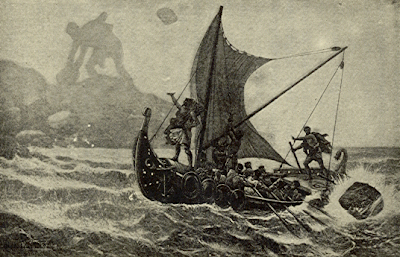


The Cyclops
retold by Ryan (age 13)


Odysseus had not forgotten to carry off some of the many sheep of the Cyclops for his companions on the other shore. There had been sheep on every ship, and Odysseus had enjoyed the largest of the rams. That day his whole company feasted, then lay on the beach and slept. When Odysseus awoke he reflected on what had happened.

His thoughts first turned to their escape from the cave of the Cyclops. That morning the flocks of the Cyclops had exited the cave out into the many fields and pastures, and the Giant had not felt the men as they had passed by him while tied underneath the sheep. When the largest ram, which Odysseus had been clinging to, passed by the Cyclops’ hand, he had stopped the ram, and Odysseus thought he had been caught. The Giant had spoken: “Why is this? You are always first in the flock to leave the cave for the fields and always the first to come back to the pens at night. Surely, you are terrified of your Master’s gouged eye which that villain No Man hath removed.” Odysseus and his men had fled safely to their ships, but once they had cast off from the shore and had been a little way out to sea, Odysseus had very foolishly taunted the great Round-Eye. When The Giant heard these shouts, he threw a great boulder toward the voice of Odysseus. The wave caused by the stone had pushed the ship back to shore, but Odysseus had cast off again with a long, metal rod. Against the will of his men he had taunted yet again but this time the large rock the Round-Eye threw at his voice landed behind them, and had pushed them farther out to sea which had allowed Odysseus and his companions to quickly sail across the channel and reach the other ships in safety.

He also remembered how he had been greatly amused that his trick of naming himself No Man had succeeded, and then his thoughts had turned to escape. The Round-Eye, now blind, had sat at the mouth of the cave, feeling of everything that passed out of the entrance. Odysseus had thought of a brilliant plan, and he had tied each one of his men to the underside of six sheep strapped together so that the Giant would not feel them as they left the cave. Odysseus, who had had no one to tie him, clung to the fleece of the greatest of the rams with both hands.

He reflected on how, before they left the cave, he had stabbed the Round Eye with the spear which he had skillfully crafted. When the Round-Eye had returned home on the second evening they were in the cave, Odysseus had given him some of his strong wine to drink. The Giant had asked his name, and Odysseus told him that he was No Man. Odysseus had given him more wine, and after drinking it the Giant fell into a drunken slumber. He thought of how he and his companions had thrust the log into the fire, and when it was red hot they had crawled onto the Giant and had stabbed it into his eye, twisting it. The Round-Eye had cried out in pain, and when the other Giants came to help him in his distress he had told them No Man was hurting him, and the neighbors had left fearing it was the gods themselves hurting their beloved friend.

Odysseus thought about how he had planned their means of escape. In the cave, there had been a great log and, although it was still green, he had severed a piece six feet long and hardened it in the blazing fire. They had then concealed the log in the narrow crevices of the cave.

He had been very sad as the hours passed while they were trapped in the cave. When the Round-Eye had woken up, he had viciously devoured two more of Odysseus’ companions for breakfast and then had taken his flocks out to the pastures and fields. Much to the surviving men’s dismay, he had rolled the large boulder back over the entrance of the cave as he left.

On the evening of the first night they were in the cave, the Round-Eye had come home and tended to his animals and his other chores before he had built up a fire whose light had revealed Odysseus and his men. He had questioned Odysseus, who had lied and told him they had been shipwrecked onto the Island. The Cyclops then, without warning, ate two of the Greeks with long swigs of milk in between his large bites. Their captor had then fallen asleep, and Odysseus had pondered how to escape, for killing the great Giant would have meant that they would have been trapped in the cave, for the large stone was at the entrance.

They had come to the cave while exploring, and the small group thought it to be the home of a very skilled Farmer, for there were large goat pens and many baskets of cheese as well as containers of milk. His men had tried to persuade him that they should take some of the goods and leave, but Odysseus had rather foolishly decided to stay and wait for the Farmer.

What had first compelled them to explore that island was when they had seen it about a mile away from the first island they had explored. They had thought this new island might be inhabited, and had decided to search it, for the Island they were on had been void of any civilization. Odysseus had rowed his ship over to it and, once his ship was aground, he had taken ashore twelve of his bravest men along with food and a very strong wine he had acquired at Isma’rus.

He remembered when he had set foot on that first island, after they had drawn their ships onto the flat beach. They had found the island was full of goats, and they had feasted on these and drunk the wine from Isma’rus.

They had been on their way home from Troy when a great storm had blown his ships far to the south, and Odysseus had even passed his homeland of Ithaca, which had been very hard on him because he was not able to anchor his ships in the ports of his long sought Island home.

Prior to the storm, Odysseus had set out from Troy with his twelve ships, and he and his men had come upon the city called Isma’rus which they had sacked and plundered. The remaining citizens of the conflict had brought their countrymen from the mountains and had attacked the Greeks, who had remained on the beach to enjoy their spoils of the battle. This had forced them to leave the island, for their opponents had fought very fiercely. After counting his men, he had realized that six had been lost from every ship.

Odysseus’ adventures had begun many years ago, when there had been a great siege of a City named Troy, where many Greek warriors had fought against the Trojans over a woman named Helen, the most beautiful woman in the world, who had been kidnapped by one of the Princes of Troy, named Paris. Odysseus had come to this Island on his way home from that terrible war.

After he had pondered these things, Odysseus and his men continued their homeward journey.

Classical Writing

We're spending a lot of time on writing this year, and the program we use is Classical Writing (CW). Zachary and Ryan have completed the Aesop and Homer levels, and are continuing in Diogenes. Catherine is continuing in Homer.

The CW method is based on the progymnasmata, a series of ancient preliminary writing exercises designed to incrementally instruct students in the arts of writing, rhetoric, and public speaking.

Here are the fourteen progymnasmata with links to further description of each:

Fable
Narrative
Chreia
Proverb (or Maxim)
Refutation
Confirmation
Commonplace
Encomium
Vituperation (or Invective)
Comparison
Impersonation (or Characterization)
Description
Thesis or Theme
Defend / Attack a Law


CW also includes intensive grammar study and literature analysis.

Have I mentioned that I really like this program? ;-)